

The Pulmonary Trap
Why Your “Wellness Drip” Won’t Fix Your Knees
A Guide to Interventional Orthobiologics and Why Delivery Matters More Than Cell Count
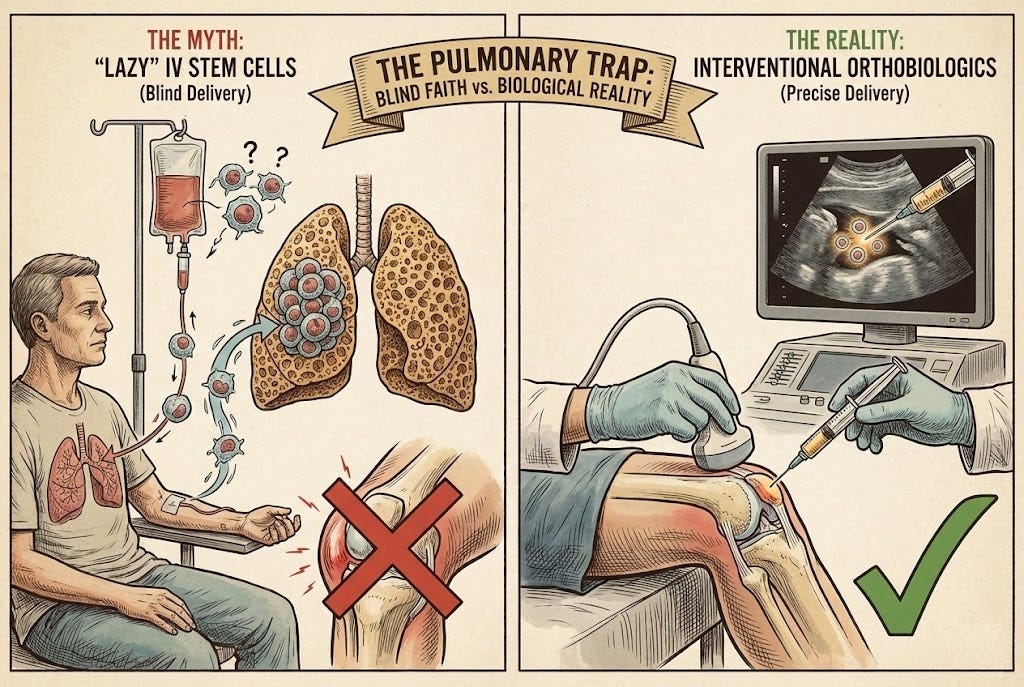
I receive DMs every single day from patients who have traveled overseas—usually to Mexico, Colombia, or Turkey seeking a miracle for their joint pain.
They have a torn meniscus, severe arthritis, or a degenerative disc. They want to avoid surgery, which is a goal I support entirely.
But their story almost always ends the same way: “Dr. Khan, I went to [Clinic X]. They gave me 100 million stem cells in an IV. They told me the cells would ‘find’ the injury. It’s been three months, and my knee still hurts. Did I get scammed?”
Here is the hard truth the industry doesn’t want to tell you: Cells are not GPS-guided missiles.
Injecting stem cells into your arm to fix a structural defect in your knee isn’t just optimistic; it is lazy medicine.
Let’s separate the marketing hype from the biological reality.
The “Pulmonary Trap”: Where Your Cells Actually Go
On paper, the idea of an IV stem cell infusion sounds fantastic. It’s non-invasive and painless, and clinics market it as a “whole-body reset.” They claim that stem cells have a homing signal that naturally directs them to inflammation.
While there is some truth to homing signals, it is vastly overstated when it comes to orthopedic injuries.
When you inject mesenchymal stem cells (MSCs) into a vein, they have to travel through your circulatory system. The first major organ they encounter is the lungs.
This effect is known as the “Pulmonary First-Pass Effect” or the “Pulmonary Trap.”
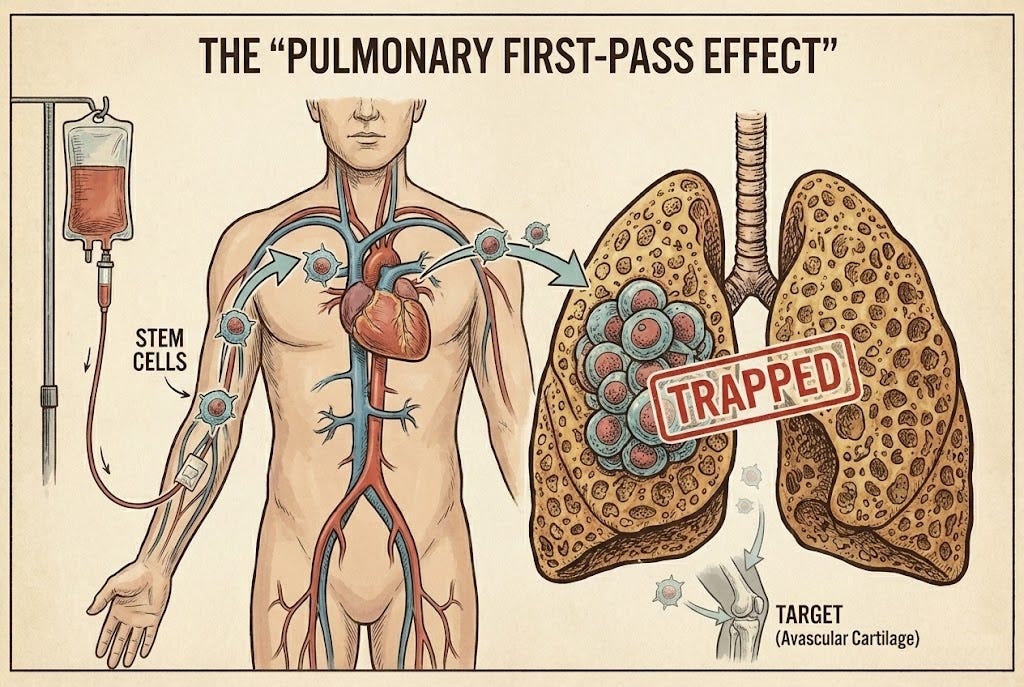
Studies suggest that over 80-90% of stem cells, due to their larger size than lung capillaries, become trapped in the lungs. From there, many are filtered out by the liver and spleen.
If you have a tear in your meniscus (which has very poor blood supply to begin with), the number of cells that survive the lungs, travel through the heart, make it to the knee, and actually penetrate the avascular cartilage is statistically insignificant.
You didn’t get a knee treatment. You got a costly lung treatment.
Why Clinics Sell “Lazy Medicine”
If the science on the Pulmonary Trap is so clear, why do so many clinics offer IVs for joint pain?
1. It requires zero skill. Any nurse or phlebotomist can hang an IV bag. It takes 5 minutes of staff time and requires no expensive equipment.
2. It has high profit margins. They charge you $5,000 - $20,000 for a “systemic flush” that costs them very little in terms of labor or liability.
3. It relies on the Placebo Effect. IV stem cells do release anti-inflammatory signals (paracrine effect) before they die. This method might make you feel “good” or “less stiff” for a few weeks. But it does not repair the tissue. Once the inflammation returns, so does the pain.
This is Shotgun Medicine: Spraying the whole body and hoping something hits the target.
The Solution: Interventional Orthobiologics
If you want to actually repair tissue—to regenerate a tendon, heal a tear, or restore cartilage—you need Engineering, not just Biology.
In my practice, I strictly use Interventional Orthobiologics. This means we are manually intervening to place the biology exactly where it is needed.
Real regeneration requires three things:
The Seed (The Cell): A viable, potent stem cell (like the MUSE cells I use).
The Soil (The Scaffold): A structure for the cells to attach to so they don’t wash away.
The Planter (The Delivery): Precise placement.
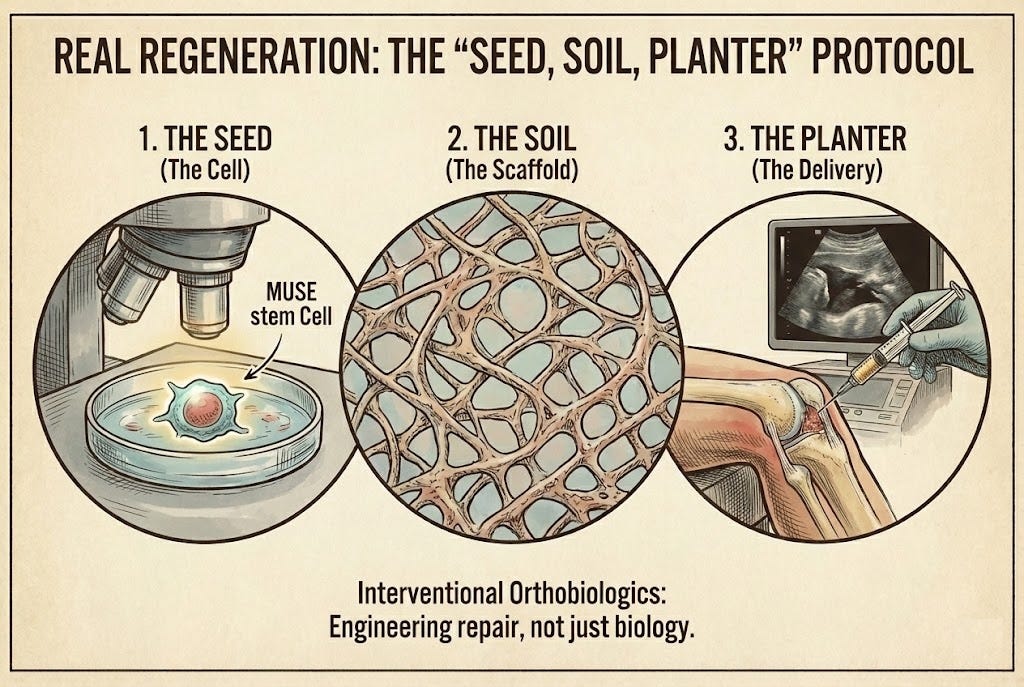
If you inject cells into a joint without guidance, you are essentially “blind.” You might hit the joint space, but you will likely miss the specific tear in the cartilage.
This is why we use Image Guidance:
Ultrasound: Allows us to see soft tissue tears in real-time and watch the needle enter the defect.
Fluoroscopy (Live X-Ray): Essential for spine and deep joint work to ensure we are in the exact millimeter required.
When we place cells inside the defect, often combining them with a scaffold (like fibrin glue or specialized matrices), we are respecting the biomechanics of the joint. We are giving the cells a home.
Your Checklist for Vetting a Clinic
If you are considering stem cell therapy for an orthopedic injury, do not be afraid to ask hard questions. If a clinic cannot answer these, walk away.
❌ The Red Flags:
They only offer IV treatments for joint pain.
They don’t use ultrasound or fluoroscopy.
They claim the cells “know where to go.”
The doctor is a generalist, not an orthopedic or sports medicine specialist.
✅ The Green Flags:
Image Guidance: They use ultrasound or C-arm fluoroscopy for every injection.
Targeted Delivery: They talk about “intra-articular” (inside the joint) or “intra-tendinous” (inside the tendon) injections.
Scaffolding: They mention using PRP, fibrin, or other agents to help the cells stick.
Honesty: They admit that IVs are for systemic health (autoimmunity, frailty), not for fixing a torn ACL.
The Takeaway
I want precision before I promise results. ➔ Not shotgun medicine. Not blind injections. Not wasted hope.
Precise delivery can regenerate tissue. Blind delivery is just expensive urine.
Your injury requires engineering. Don’t let a clinic sell you a “wellness drip” and tell you it’s a surgery replacement.
How We Can Help
At Eterna Health, we specialize in Interventional Orthobiologics. We don’t guess. We verify. If you are tired of treatments that don’t last, let’s look at your imaging and build a plan that respects the biology and the physics of your injury.
Great info to share with clients searching for orthobiologic treatments. Do you have a reference of this first pass stem cell trap to back up skeptical clients. Thank you!